Smarter Credit Decisioning For Vehicle Financing
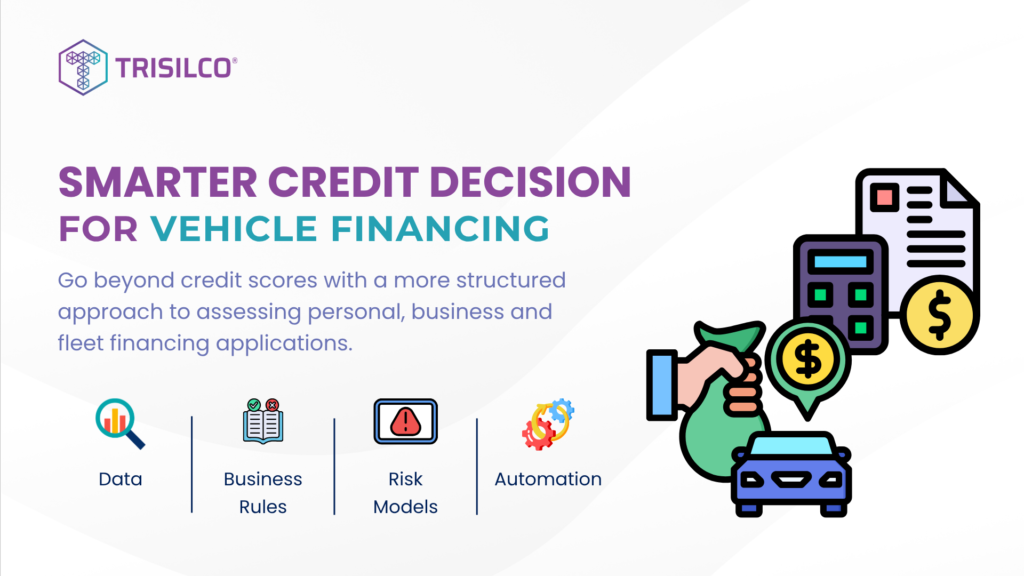
Vehicle financing helps individuals and businesses acquire vehicles for personal use, daily operations, or business expansion. From personal cars to commercial trucks and larger fleets, financing requirements vary depending on the applicant’s financial circumstances and intended use.
Credit decisioning for vehicle financing brings relevant information, risk models, and lending policies together to support more consistent and informed financing decisions.
For business, this may include fleet financing, which supports the acquisition of multiple vehicles for operational needs or expansion.
And for lenders, assessing vehicle financing applicants involves more than checking a credit score. Income, financial commitments, credit history, cash flow, and other relevant risk factors may also influence an applicant’s ability to meet repayment obligations.
Why Vehicle Financing Requires More Than A Credit Score
Credit scores provide a useful indication of credit risk, but they do not always reflect an applicant’s full financial circumstances. Effective credit decisioning for vehicle financing requires lenders to look beyond credit scores and consider other relevant factors. An individual may have a strong credit history but significant existing loans, while a business may generate stable revenue but experience cash flow fluctuations.
Depending on the application, lenders may need to consider different factors.
Personal Vehicle Financing
For personal vehicle financing, lenders may assess:
- Income and employment stability
- Credit and repayment history
- Existing loans and financial commitments
- Debt obligations relative to income
- Financing amount, tenure and down payment
These factors help lenders evaluate whether an applicant can reasonably meet the proposed repayment obligations.
Business Vehicle Financing
Business vehicle financing may require additional considerations, particularly when vehicles support business operations or generate revenue.
Lenders may assess:
- Business financial and cash flow
- Business credit history and existing obligations
- Business and industry profile
- Number, type and intended use of vehicles
- Vehicles value, financing amount and tenure
For fleet financing, the assessment may also involve the underlying vehicles and their value. Vehicle valuation and condition are also discussed in this commercial vehicle valuation and technical due diligence case study.
The specific assessment criteria will depend on the lender’s policies, financing arrangement, and available information.
From Credit Scoring To Credit Decisioning
Credit scoring assesses risk based on defined factors, while credit decisioning determines what action should follow that assessment.
Depending on the lender’s policies and risk appetite, an application may be:
- Approved automatically
- Referred for further assessment
- Approved with specific conditions
- Declined based on defined criteria
Personal vehicle financing may focus on individual repayment capacity and eligibility, while business and fleet financing may require a broader assessment of corporate financial profiles and operational requirements.
A centralised decisioning platform can help integrate relevant credit information, apply lending policies consistently and connect assessment results with approval workflows.
Bringing Data, Rules And Models Together
An effective credit decisioning process combines relevant data, business rules, and risk models to support financing decisions.
A simplified process looks like:
Application > Data Integration > Credit Assessment > Rules & Risk Models > Decision > Approval Workflow
Personal applications may focus on income, credit history, and existing commitments. Meanwhile, business applications may require business financials, cash flow, and operational information.
A credit risk assessment case study by Volkswagen Financial Services illustrate the use of financial statement analysis, internal rating models and workflows for corporate clients, including fleet leasing clients.
By bringing these elements together, lenders can create a more structured approach to evaluating applications and applying lending policies.
Combining AI, Business Rules And Automation
AI and machine learning can help identify patterns in available data and provide additional insights for credit risk assessment. However, they do not replace clear lending policies or defined decision criteria.
Business rules establish eligibility requirements, risk threshold, and approval conditions, while risk models provide additional input for evaluating applications. Automation can help process straightforward applications that meet established criteria, while more complex cases can be referred to credit officers for further review.
The objective is not to automate every decision, but to improve efficiency while maintaining appropriate human oversight and control over lending decisions.
Improving Consistency And Explainability
As financing volumes grow, maintaining consistent decisions across product, teams and customer segments can become more challenging.
A centralised decisioning approach can help lenders apply relevant rules and policies consistently while allowing flexibility for different applicant profiles.
Lenders also need visibility into how decisions are reached. Maintaining appropriate records of decision logic, model versions and assessment outcomes can help credit teams review decisions, investigate issues and support effective governance.
Together, consistency and explainability helps lenders manage risk while maintaining a structured decision-making process.
Building A Smarter Vehicle Financing Process
Smarter vehicle financing is not simply about generating better credit score. It involves combining several capabilities:
- Data provides a broader view of applicant’s financial circumstances.
- Business rules help apply lending policies consistently.
- Risk models support structured credit risk assessment.
- Automation accelerates suitable routine decisions.
- Human judgement support the review of complex applications.
For personal financing, this means considering repayment capacity and existing commitments. For business and fleet financing, it also means understanding cash flow, operational requirements, and relevant asset considerations.
By bringing these capabilities together, financial institutions can support a more structured approach to vehicle financing, improve decision consistency, and manage credit risk across different applicant profiles.
Looking to strengthen your credit decisioning for vehicle financing?
Contact marketing@trisilco.com to learn more about our credit decisioning solutions and how they can support your lending processes.

Putera Harith
Develops marketing strategies to attract customers and strengthen brand awareness. Passionate about video content creation, editing, communication, and graphic design, he ensures marketing efforts remain dynamic, relevant, and impactful in a rapidly evolving industry.